By Dr. John L. Ferrell III, M.D.(*)
⚡ Quick Answer: What Can Regenerative Medicine Do for a Summer Sports Injury?
- The conventional approach (rest, ice, cortisone) manages symptoms. It does not repair tissue.
- Treatments like PRP, Prolotherapy, and EPAT use your body’s own biology to accelerate actual healing.
- Most summer sports injuries, including runner’s knee, tennis elbow, rotator cuff strains, and plantar fasciitis, respond well to regenerative treatment.
- ROSM physicians use same-visit musculoskeletal ultrasound to diagnose the injury precisely, then target treatment directly to the damaged area.
Summer in the DC, Maryland, and Virginia region has its own rhythm. The W&OD Trail fills up before 7 a.m. The Capital Crescent gets crowded on weekends. Pickleball courts are booked two weeks out. Tennis leagues run through September. And every year, a significant number of active adults reach July nursing something that has not quite healed: a knee that swells after a long run, a shoulder that aches through a backswing, an Achilles that protests every morning.
The standard advice is predictable: rest it, ice it, do some physical therapy, and if it does not improve, a surgeon will talk to you about your options. That advice works for some injuries. For many others, especially soft tissue injuries that are not healing on their own, it simply delays the conversation that should have happened earlier.
This is where regenerative medicine comes in.
The Conventional Summer Sports Injury Playbook
When most athletes get hurt, the first line of response is some version of RICE: rest, ice, compression, elevation. That protocol helps with acute inflammation in the first 48 to 72 hours. Beyond that, it is largely a waiting game.
If the injury does not resolve with rest and physical therapy, the next step in traditional sports medicine is usually a cortisone injection to reduce inflammation. Cortisone can provide real, if temporary, relief. What it does not do is repair the structure that is causing the problem. Research has shown that repeated cortisone injections can actually weaken tendon tissue over time and may accelerate cartilage breakdown in joints. This matters for athletes because the very tissue that needs to heal is being further compromised.
The end of the conventional road is surgery. For some injuries, surgery is absolutely the right call. For many others, patients find themselves in the operating room not because surgery was the best option, but because nothing else was offered.
Why the Body Sometimes Needs Help Healing Itself
Soft tissue injuries present a specific biological challenge. Tendons, ligaments, and cartilage have relatively poor blood supply compared to muscle. That poor blood supply means the growth factors and repair signals your body uses to heal tissue are slow to arrive at the injury site and present in low concentrations when they get there.
This is the biological reality that regenerative treatments are designed to address. Rather than masking the pain or waiting for a process that is already struggling, these therapies introduce concentrated healing signals directly to the damaged area.
Platelet-Rich Plasma, or PRP, concentrates the growth factors from your own blood and delivers them via ultrasound-guided injection precisely to the injured tissue. Prolotherapy uses a dextrose solution to create a controlled inflammatory response that triggers the body’s repair cascade. EPAT (Extracorporeal Pulse Activation Treatment) uses acoustic pressure waves to stimulate tissue regeneration and increase blood flow to chronic, stubborn injuries.
None of these treatments are experimental. PRP for tendinopathies and soft tissue injuries is supported by multiple randomized controlled trials. EPAT is FDA-cleared and used widely in sports medicine for plantar fasciitis, Achilles tendinopathy, and chronic tendon problems. The question is not whether these treatments work. It is whether you have been told they exist.
The Most Common Summer Sports Injuries We Treat at ROSM
The following are the injuries that bring the most athletes and active adults through our doors in June, July, and August. Each one responds to a different combination of regenerative approaches depending on the severity and chronicity of the damage.
Runner’s Knee and Patellar Tendinopathy. Runner’s knee is a broad category that includes conditions like patellofemoral syndrome and patellar tendinopathy. Both are overuse injuries that worsen with increased mileage or activity, and both are common when summer training ramps up faster than the body is ready for. Physical therapy addresses movement patterns and muscle imbalances. For the tendon itself, PRP injections delivered under ultrasound guidance target the tissue directly and support structural repair. For a deeper look at how we work up knee pain in runners, see our Runner’s Guide to Knee Pain.
Tennis and Pickleball Elbow. Lateral epicondylitis (tennis elbow) and its medial counterpart are reaching near-epidemic levels in the DC region, driven largely by the pickleball surge. The tendon where the forearm muscles attach to the elbow is a notoriously slow-healing structure because of its limited blood supply. Cortisone provides faster relief in the first few weeks, but multiple systematic reviews and meta-analyses of randomized controlled trials, including a widely cited analysis published in the Journal of Shoulder and Elbow Surgery (PMC6940118), have found PRP produces better pain and function outcomes than cortisone by the six-month mark and beyond. We break this comparison down in more detail in Tennis Elbow Treatments: PRP vs. Corticosteroids vs. Autologous Blood Injections.
Rotator Cuff Strains. Partial rotator cuff tears and supraspinatus tendinopathy are among the most common shoulder injuries in recreational athletes, particularly swimmers, overhead athletes, and anyone who spends time in the gym. Surgery is often recommended for partial tears, but research increasingly supports PRP and, for more complex cases, microfragmented adipose tissue (MFAT) as effective non-operative alternatives that support tissue healing without the six-to-twelve month surgical recovery. See our full comparison in PRP vs. Cortisone for Rotator Cuff Tears.
Plantar Fasciitis. Plantar fasciitis peaks in summer when runners increase volume and athletes spend more time on hard surfaces. The fascia becomes inflamed at its heel attachment point, and for many patients, that inflammation becomes chronic. EPAT is particularly effective for plantar fasciitis and Achilles tendinopathy, and for patients who have tried cortisone without lasting results, our PRP vs. Cortisone for Plantar Fasciitis article covers why the regenerative option tends to hold up better over time.
Ankle Sprains and Ligament Injuries. A single bad ankle sprain that is not properly treated can lead to chronic instability and recurring injuries. Prolotherapy is well-established for chronic ligament laxity and can help tighten and strengthen the ligament complex that was damaged in the original injury, reducing the likelihood of re-injury.
How ROSM Approaches a Summer Sports Injury
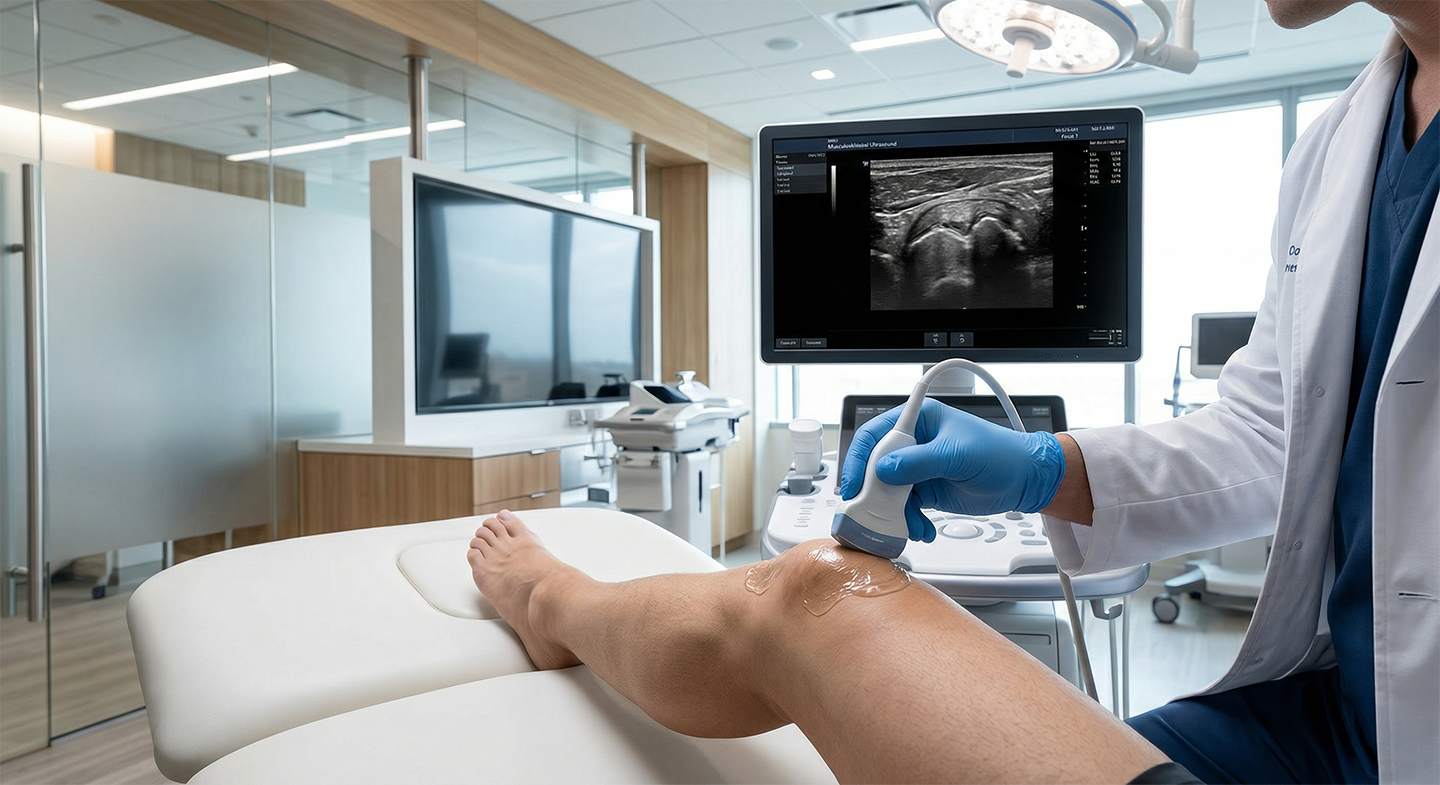
Every evaluation at ROSM begins with diagnostic musculoskeletal ultrasound. Unlike an MRI, ultrasound happens in the clinic during your first visit. Our physicians can visualize the tendon, ligament, or joint in real time, see the extent of the damage, and, in many cases, begin treatment the same day.
That precision matters. Ultrasound-guided injections are more accurate than blind injections, and accuracy translates to better outcomes. When we place PRP directly into the area of tendon degeneration rather than approximately nearby, the treatment does what it is designed to do.
After diagnosis, the treatment plan depends on what the imaging shows, how long the injury has been present, and what you have tried before. Most athletes see meaningful improvement within four to six weeks of their first treatment. Some require a second treatment. Recovery is generally measured in weeks, not months, and does not involve general anesthesia or surgical rehabilitation.
What the Timeline Actually Looks Like
One of the most common things patients say when they come to ROSM is that they were told to wait and see how the injury progressed. Waiting does have a role in acute injuries. For injuries that have been present for eight weeks or more without significant improvement, waiting is rarely a strategy with a good outcome.
Regenerative medicine does not guarantee speed. Tissue repair takes time regardless of how it is prompted. What it can offer is a more direct path: rather than managing symptoms while hoping the body eventually does what it could not do on its own, these treatments give the body the concentrated signals it needs to actually repair the structure.
Most patients who come to us in June or July with a summer injury are back to full activity by September. Some are back sooner. The goal is not just to get you through the season. It is to get the injury actually healed.
Frequently Asked Questions
Q: Am I a candidate for PRP or regenerative treatment if I just got injured this summer?
A: It depends on the injury. For acute injuries (less than two weeks old), we typically recommend a period of relative rest and physical therapy first. For injuries that are not healing as expected after four to six weeks, or for injuries that recurred after a previous season, regenerative treatment is often appropriate. A diagnostic ultrasound evaluation gives us a clear picture of what the tissue looks like and whether treatment is indicated.
Q: Is EPAT painful?
A: Most patients describe EPAT as a pulsing or tapping sensation that ranges from mildly uncomfortable to temporarily sharp depending on the location and sensitivity of the area being treated. The session typically lasts about 15 to 20 minutes. There is no downtime and no anesthesia required.
Q: How many PRP treatments will I need for a summer sports injury?
A: Most soft tissue injuries respond well to one to two PRP treatments. Tendons with more significant degeneration or injuries that have been present for longer than six months may require a second injection four to six weeks after the first. Our physicians will outline a realistic treatment plan based on what the ultrasound shows.
Q: Does insurance cover PRP or EPAT?
A: Most regenerative treatments, including PRP, Prolotherapy, and MFAT, are not covered by standard insurance because they are classified as experimental by major carriers despite strong clinical evidence. EPAT coverage varies. We discuss all pricing transparently at your first visit. For most patients, the cost of one or two regenerative treatments is significantly lower than the cost of surgical intervention and the months of recovery that follow.
Q: Can I keep training while receiving treatment?
A: In most cases, yes, though activity is modified based on the injury and the treatment phase. Our physicians will give you specific guidelines. The goal is to keep you as active as safely possible during the recovery process, not to sideline you entirely.
Conclusion
Summer sports injuries do not have to derail the next three months of your life. The conventional path of rest, cortisone, and eventually surgery is not the only path. Regenerative treatments like PRP, EPAT, and Prolotherapy work with your body’s own repair biology to address the structural problem, not just the symptoms.
If you are dealing with a nagging summer injury in the DC, Maryland, or Virginia area, our team at ROSM can evaluate the injury with same-visit ultrasound imaging and walk you through your options at any of our eight locations.