
You have already read about what Stellate Ganglion Block can do. This page is about what actually happens when you are on the table, why the details of the technique matter, and the research behind it.
SGB is an evidence-based, FDA-cleared procedure with an 85%+ success rate in properly screened patients. It is not a surgery. There is no incision, no sedation, no radiation and no hospital stay. The initial counseling and procedure take about 30 minutes, and most patients leave the office within an hour of their appointment time.
What Happens During an SGB Procedure
Here is the sequence, start to finish:
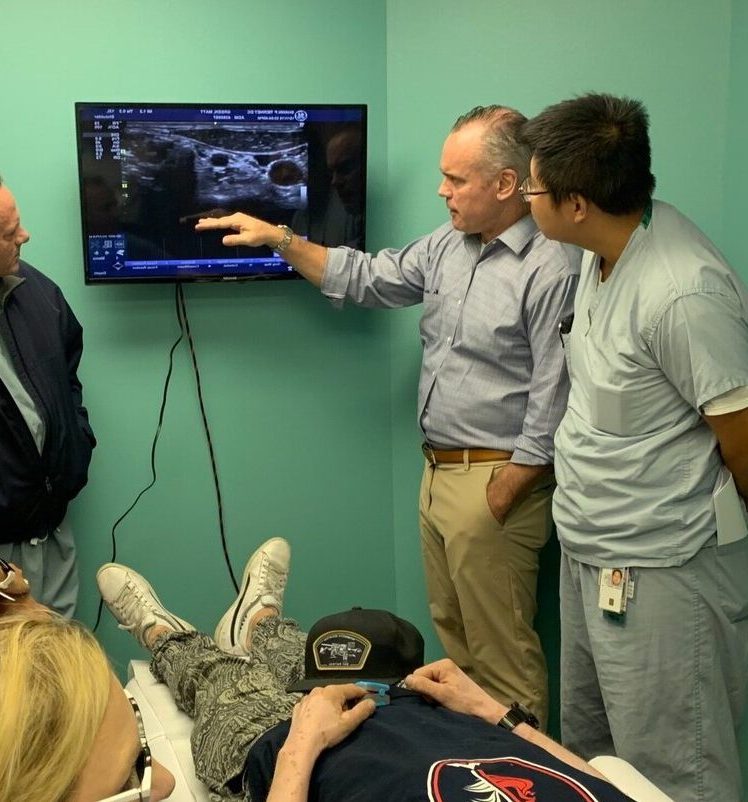
Dr. Sean Mulvaney walks a team through a live ultrasound image of the neck. He has performed more than 5,300 ultrasound-guided SGBs since 2009, and the protocol he developed guides every step described below. Photo courtesy of the SGB Treatment Center.
Step 1: Positioning and ultrasound mapping. You lie on your back with your neck slightly turned. Before anything is injected, your physician uses a high-resolution ultrasound probe to map the stellate ganglion, a bundle of nerves that sits deep in the neck alongside the carotid artery, jugular vein and thyroid. This is not a landmark-guided injection done by feel. Every structure is visualized in real time.
Step 2: The injection. Using that ultrasound image as a guide, your physician advances a thin needle to the precise location and places a long-acting local anesthetic (ropivacaine) around the nerve bundle. The needle is watched on screen the entire time.
Step 3: What you feel. Most patients describe a brief pressure or fullness in the neck during the injection. Within minutes, you may notice warmth spreading down the arm on the treated side, or a temporary drooping of the eyelid and a smaller pupil (Horner’s syndrome). This is expected. It is a sign the block is working, not a complication. Dr. Mulvaney developed and published a grading scale for these Horner’s signs, so the team can confirm each block took effect.
Step 4: The reset. As the anesthetic takes effect, it interrupts signaling through the cervical sympathetic chain, the pathway connecting the brain’s fear and alarm centers to the rest of the body. Many patients report a noticeable sense of calm within 30 minutes. The numbing medicine wears off within hours, but the brain’s natural neuroplasticity allows the calmer state to last much longer.
Why Ultrasound Guidance Matters More Than Most Patients Realize
Not every clinic offering SGB uses ultrasound. Some use fluoroscopy (X-ray guidance), which shows bone but not the soft tissue around it. The stellate ganglion sits in a tight neighborhood of vital structures: the carotid artery, the vertebral artery, the jugular vein, the thyroid and the top of the lung. Ultrasound lets your physician see nerves, blood vessels and soft tissue directly, which makes the procedure safer, more precise and more comfortable. It also means no radiation exposure and no contrast dye.
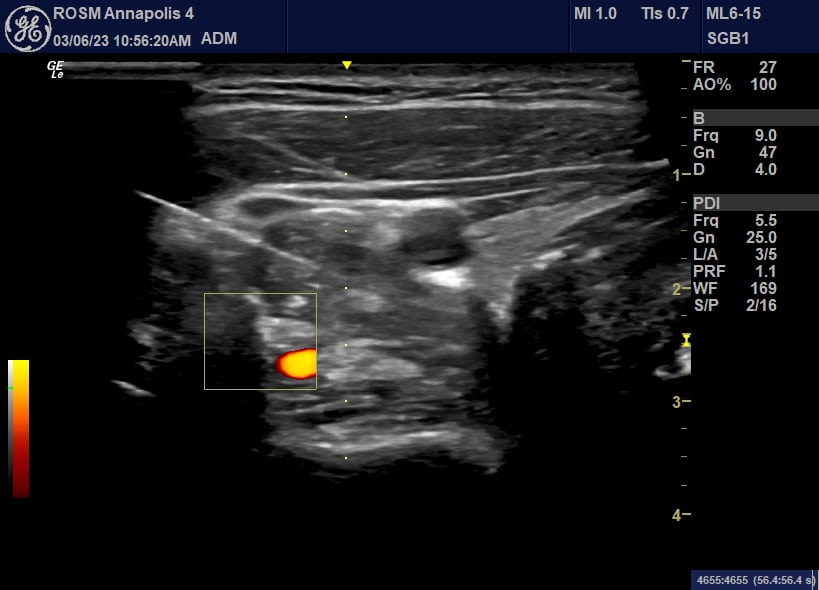
What the physician sees during an SGB: a live ultrasound view of the neck, with blood flow highlighted in color so vessels can be avoided. Image courtesy of the SGB Treatment Center.
Dr. Mulvaney’s Protocol: Two Levels, Both Sides, Two Days
Dr. Sean Mulvaney began using SGB for combat-related post-traumatic stress in 2009, as the first Department of Defense physician to do so. Since then he has performed more than 5,300 ultrasound-guided SGBs for military and civilian patients, more than any other physician worldwide, and published 23 peer-reviewed studies on the procedure, more original SGB research than any other scientist in the world. His work has been featured on CBS 60 Minutes and in the Wall Street Journal. Three refinements from that work define how SGB is done at ROSM:
- Two levels, not one. The block is placed at two points on the nerve chain, C6 and C4, rather than at C6 alone. Dr. Mulvaney’s 2020 analysis of 147 patients found that two-level blocks may provide greater benefit than a single-level block, and two levels are now standard practice.
- Both sides, when needed. Treatment typically starts on the right side. A left-sided block can follow, and his 2021 analysis of 205 patients found that some patients who do not respond to a right-sided block respond strongly to the left.
- On separate days, for safety. The SGB Treatment Center recognizes a theoretical risk of airway blockage if both sides are blocked within six hours of each other. Performing the second side the following day, at least 12 hours later, eliminates that risk. Patients traveling from out of town plan for an overnight stay.
Is SGB Right for You? Who Tends to Benefit
SGB was developed and has been most extensively studied for post-traumatic stress, but the underlying problem, a sympathetic nervous system stuck in a heightened “on” state, shows up in more than one diagnosis. Patients who tend to see the most benefit include:
- Combat veterans, active military and first responders carrying PTSD symptoms from repeated exposure to trauma.
- Survivors of sexual trauma, childhood abuse, assault, a serious accident or a medical emergency.
- Patients whose symptoms have not responded fully to talk therapy or medication alone.
- People living with persistent, generalized anxiety.
- Patients with traumatic brain injury who experience symptoms that overlap with, but are distinct from, PTSD.
That last group is worth pausing on. A 2024 study in Brain Sciences, led by Dr. Mulvaney, looked at whether SGB could improve TBI symptoms independent of PTSD, using the bilateral, two-level technique. Among the 20 patients studied, TBI-specific symptom scores dropped from a baseline average of 15.45 to 7.80 at one month, roughly a 50% improvement, in symptoms that had nothing to do with PTSD or anxiety overlap (read the study).
SGB is not a fit for everyone. It is generally not recommended for patients with certain bleeding disorders, active infection at the injection site or specific cardiac conduction abnormalities. A consultation is where your physician reviews your history against these factors directly.
The Research Behind SGB
Dr. Mulvaney’s published work spans PTSD, anxiety and traumatic brain injury, in journals including JAMA Psychiatry, Military Medicine, Pain Practice and Brain Sciences. A few of the key studies:
- PTSD, randomized clinical trial (2019): a landmark trial in JAMA Psychiatry, co-authored by Dr. Mulvaney, found SGB reduced PTSD symptoms at roughly twice the rate of a placebo injection. Read the study.
- PTSD, six-month durability (2025): in 75 patients treated with bilateral two-level SGB, 96% still showed improvement at six months, with an average 55% reduction in PTSD symptom scores. Read the study.
- SGB plus talk therapy (2025): an Ohio State University randomized trial of 86 service members and veterans found that SGB given before cognitive processing therapy produced faster symptom relief, and that patients who had not responded to therapy alone improved after SGB. Read the study.
- Anxiety (2023): a case series of 285 patients found SGB cut anxiety scores roughly in half, with bilateral blocks outperforming single-sided blocks. Read the study.
- Generalized anxiety, three-month durability (2025): 86.8% of 114 patients improved, with average anxiety scores falling 52% and holding at three months. Read the study.
- Traumatic brain injury, three-month durability (2025): 85.4% of 41 patients improved, with an average 48% drop in neurobehavioral symptom scores sustained at three months. Read the study.
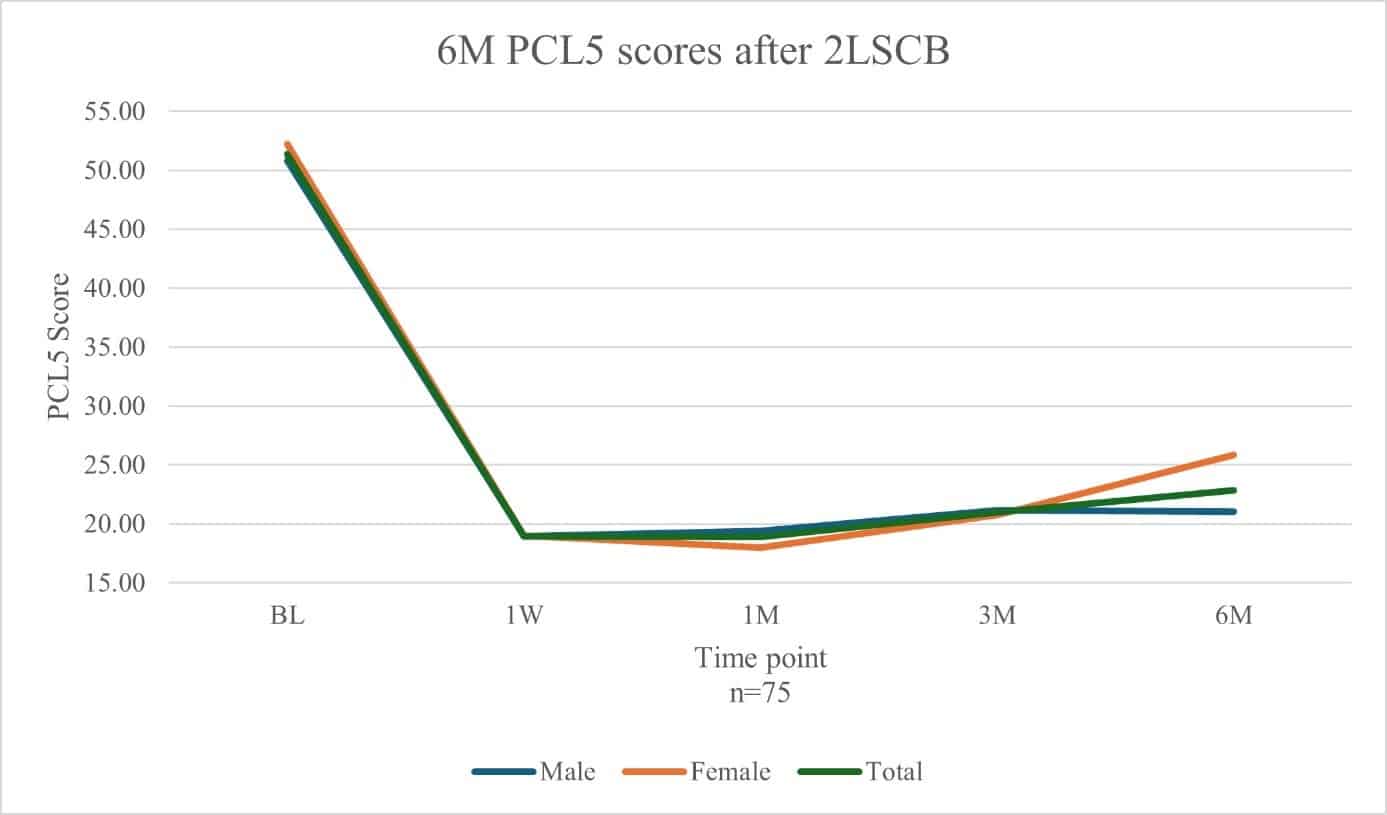
PTSD symptom scores (PCL-5) for 75 patients at baseline, 1 week, 1 month, 3 months and 6 months after bilateral two-level SGB. Scores dropped quickly and stayed down through six months. Graph courtesy of the SGB Treatment Center.
The full list of Dr. Mulvaney’s 23 published studies is available on the SGB Treatment Center research page.
What a Consultation and Follow-Up Look Like
No referral is required. Your first step is a simple intake: a HIPAA-compliant form plus three short screening questionnaires, the PCL-5 (post-traumatic stress), the GAD-7 (anxiety) and the NSI (neurobehavioral symptoms). These give your physician a baseline to measure your response against.
At your visit, your physician reviews your history, current symptoms and prior treatments, then walks through whether SGB is a reasonable option for you. If you move forward, here is what to plan for after the procedure:
- No driving for 6 hours. Bring a driver or plan a ride home.
- Temporary hoarseness is common. About 1 in 5 patients notice a hoarse voice that resolves within 3 to 6 hours. This is normal.
- Follow-up. Your team checks in on your response using the same screening questionnaires, since benefit can build over the days after the injection.
SGB works best alongside behavioral health support. It provides the physical reset; therapy does the emotional work of healing. Our team works closely with referring behavioral health professionals and can recommend providers if you do not already have one.
Cost and Insurance
Most insurance plans do not cover SGB when it is used for PTSD, anxiety or TBI-related symptoms, since these uses are considered off-label even though the same injection is widely recognized for certain pain conditions. This means most patients pay out of pocket for SGB used for trauma-related symptoms. Our team can walk you through the specifics for your situation during a consultation, including what portion, if any, your plan may reimburse.
If You Need Help Right Now
If you are currently having thoughts of suicide, please reach out for support immediately.
- National Suicide & Crisis Lifeline: Call or text 988
- Veterans Crisis Line: Call 988 and press 1, or text 838255
Ready to Talk to Someone About SGB?
You do not have to carry a nervous system stuck in overdrive indefinitely. If you would like to find out whether SGB is a reasonable option for what you are experiencing, we see patients across our DC, Maryland and Virginia locations, including Dr. Mulvaney’s SGB Treatment Center at ROSM Annapolis.
Clinical details, research summaries and select images on this page are courtesy of Dr. Sean Mulvaney’s SGB Treatment Center and drseanmulvaney.com.

Get an Appointment
Complete The Form Below And We’ll Get Back To You Immediately.