
By Dr. Sean Mulvaney, M.D.(*)
⚡ Quick Answer
- SGB is an outpatient injection of local anesthetic into a cluster of sympathetic nerves in the neck, placed under real-time ultrasound guidance.
- It does not treat PTSD psychologically. It temporarily resets an overactive fight-or-flight response so the nervous system can settle enough to engage with therapy.
- A 2020 sham-controlled randomized trial in JAMA Psychiatry found that two injections given two weeks apart significantly reduced PTSD symptom severity compared with a saline sham.
- Patients who respond often notice reduced hyperarousal, improved sleep, and lower anxiety within days to two weeks.
- SGB is not a cure and not a replacement for therapy. It is most useful for patients who have not fully responded to medication or psychotherapy alone.
For some patients with PTSD, the most difficult part of treatment is not the therapy itself. It is getting the nervous system calm enough to engage with it. When the body is locked in a state of chronic hyperarousal, even well-delivered trauma-focused therapy can feel like trying to have a conversation in a burning building.
Stellate ganglion block addresses that problem directly, not by treating PTSD psychologically, but by interrupting the physiological alarm state that makes everything else harder. The DC, Maryland, and Virginia region has one of the highest concentrations of active military, veterans, law enforcement, intelligence professionals, and first responders in the country. Many of these individuals have lived with PTSD symptoms for years while managing high-demand jobs. SGB has emerged as one of the most clinically supported options for this population, and ROSM’s own Dr. Sean Mulvaney is among the physicians who helped pioneer its use for trauma.
What Is the Stellate Ganglion and Why Does It Matter for PTSD?
The stellate ganglion is a bundle of sympathetic nerve cells located on either side of the neck, just in front of the cervical vertebrae. It is part of the sympathetic nervous system, which governs the fight-or-flight response. When you experience threat, the stellate ganglion and the broader sympathetic network activate: heart rate increases, muscles tense, the amygdala goes on alert, and the body prepares to respond.
In a healthy nervous system, this activation subsides once the threat passes. In PTSD, that shutoff mechanism is disrupted. One widely cited working model, developed by Dr. Eugene Lipov and colleagues, proposes that nerve growth factor (NGF), a protein that promotes the growth and maintenance of nerve cells, becomes overexpressed in the sympathetic nervous system following traumatic stress. This overexpression may help hardwire the nervous system into a persistent state of threat readiness. It is an influential and widely cited hypothesis in the SGB literature, though it remains a working model rather than a fully proven mechanism.
SGB involves injecting a long-acting local anesthetic into the tissue surrounding the stellate ganglion under ultrasound guidance. The anesthetic temporarily blocks nerve signal transmission through that ganglion. The proposed effect is a reset of the sympathetic nervous system’s baseline, reducing the elevated activity and returning the fight-or-flight threshold closer to normal.
What the Research Shows
The clinical evidence for SGB in PTSD has grown substantially over the past decade, with the most significant milestone being a 2020 randomized controlled trial published in JAMA Psychiatry.
The Rae Olmsted et al. study enrolled active-duty service members with PTSD and compared two SGB injections (given two weeks apart) against a sham procedure in which patients received an injection of saline at the same anatomical location. The SGB group showed statistically significant reductions in PTSD symptom severity on standardized outcome measures compared to the sham group.
A 2025 systematic review and meta-analysis published in the journal Autonomic Neuroscience (Yang et al., ScienceDirect) reviewed the accumulated evidence on SGB for PTSD and found meaningful symptom reduction across the pooled trials, while also noting that the number of high-quality randomized controlled trials remains limited and that more research is needed to establish a precise, generalizable response rate. For context, first-line pharmacological treatments for PTSD have an estimated response rate of approximately 45 to 65 percent, but they come with side effect profiles and access barriers that SGB does not. SGB’s tolerability in clinical trials has been notably high, with serious adverse events being rare when the procedure is performed under imaging guidance.
The VA has reviewed the SGB evidence and describes it as showing a reassuring safety profile with some evidence of short-term benefit, though it is not yet considered an established, conclusively-proven first-line treatment. It is not currently a standard first-line VA treatment, but a growing number of VA facilities have begun offering it as an adjunct option, and federal legislation (the TREAT PTSD Act) has been introduced in Congress to formalize veteran and Tricare access to SGB and require it be incorporated into the VA/DOD Clinical Practice Guideline for PTSD.
Who Benefits Most from SGB
Not every PTSD presentation responds equally to SGB. The clinical literature suggests that patients with hyperarousal-dominant PTSD symptoms tend to show the strongest response. These are the patients for whom the sympathetic nervous system dysregulation is the central driver of symptoms: persistent difficulty sleeping, exaggerated startle responses, irritability and angry outbursts, hypervigilance, and the physical sense of being unable to relax even in safe environments.
Patients who have already completed trauma-focused therapy but continue to struggle with the physiological arousal component may find that SGB addresses what therapy could not. In some cases, patients use SGB before or alongside therapy specifically because the reduced arousal makes engagement with the material more manageable.
SGB is also relevant for people who have not yet been able to engage meaningfully with therapy due to the severity of their hyperarousal. When the nervous system is running too hot, therapy is hard to absorb. SGB can create a window.
The procedure is used for veterans and active-duty military, but the civilian PTSD population in this region is substantial. Law enforcement officers, Capitol and Metro Police, federal agents, emergency medical personnel, firefighters, and civilian trauma survivors are all populations where PTSD is underdiagnosed and undertreated. SGB is not a veteran-only treatment. The mechanism does not discriminate by the source of the trauma.
What to Expect at ROSM
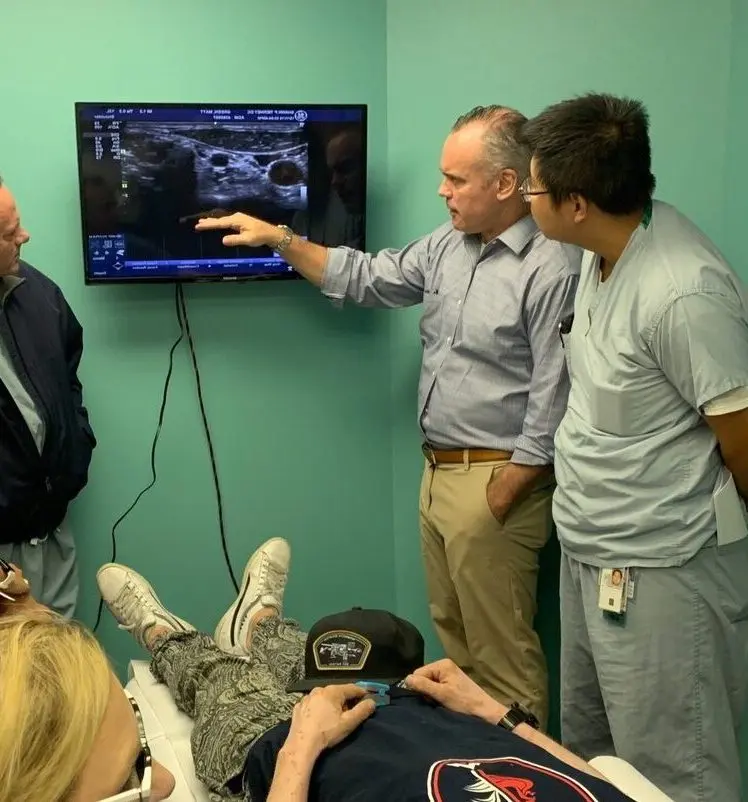
At ROSM, SGB is performed under real-time ultrasound guidance. The imaging allows the physician to visualize the needle placement precisely in relation to the surrounding structures, including the carotid artery and the cervical vertebrae, before injecting. This significantly reduces the risk compared to older anatomical landmark techniques.
The procedure takes approximately 20 to 30 minutes including preparation. Most patients experience a temporary Horner’s syndrome immediately after the injection, which includes a drooping eyelid, smaller pupil, and reduced sweating on the same side of the face as the injection. This is a normal and expected sign that the block is working, and it resolves within a few hours as the anesthetic wears off.
Patients are monitored briefly after the procedure and typically go home the same day. Most are advised to arrange for a ride home. Significant improvement in PTSD symptoms often begins within 24 to 72 hours and may continue to develop over two weeks.
What Is the “God Shot”? The Dual Sympathetic Reset, Explained
Patients researching SGB online will encounter the term “god shot,” which refers colloquially to the Dual Sympathetic Reset (DSR): a bilateral SGB protocol in which both the right and left stellate ganglia are injected, typically in two separate sessions. The term is informal and not used in clinical literature.
The rationale behind the bilateral approach is that the sympathetic nervous system is bilateral, and some patients do not achieve full symptom relief from a single-sided block. Not every patient needs a bilateral approach, however. A single-side SGB is effective for many patients, and where a bilateral protocol is used, it is typically reserved for non-responders or partial responders to an initial unilateral block. If you have read about DSR and are wondering whether it applies to your situation, that is a question worth bringing directly to your evaluation, since the right approach depends on your individual symptom pattern and response.
Frequently Asked Questions
Q: Is the stellate ganglion block FDA-approved for PTSD?
A: SGB is not currently FDA-approved specifically for PTSD. It is administered off-label, meaning it is a procedure with an established safety profile for other indications (including hot flashes and certain pain conditions) that has clinical evidence supporting its use for PTSD. Off-label use is common in medicine and does not mean the treatment is experimental or without evidence. Multiple peer-reviewed clinical trials support SGB’s potential for PTSD symptom reduction.
Q: How long does SGB take to work for PTSD?
A: Many patients notice meaningful changes within 24 to 72 hours of the procedure. The full effect may continue developing over two weeks. Some patients describe the change as gradual and steady; others describe a more abrupt shift in their baseline anxiety level. Individual response varies.
Q: How long do the effects of SGB last?
A: Clinical trial data and patient-reported outcomes suggest that a successful SGB response typically lasts several months. Some patients maintain improvement for a year or longer, particularly when the reduced arousal is used as an opening for sustained engagement in therapy. Patients who experience recurrence of symptoms may benefit from a repeat injection.
Q: Is SGB covered by insurance for PTSD?
A: Most commercial insurance plans and Medicare do not currently cover SGB for PTSD, as it remains an off-label indication. Legislation has been introduced in Congress (the TREAT PTSD Act) that would formalize Tricare and VA coverage of SGB for eligible veterans and service members with a PTSD diagnosis, though coverage rules can vary and change. ROSM’s billing team can discuss current out-of-pocket cost and whether HSA/FSA funds apply.
Q: Can SGB be used alongside medication or therapy for PTSD?
A: Yes. SGB is not a replacement for evidence-based PTSD treatment. It is most effective when used as a complement to therapy, particularly trauma-focused approaches like cognitive processing therapy (CPT) or EMDR. The reduction in physiological hyperarousal that SGB produces can make it meaningfully easier to engage with and benefit from therapy.
Conclusion
Stellate ganglion block is not a cure for PTSD, and any provider presenting it as one deserves scrutiny. What it is, supported by sham-controlled randomized trial data, is a physiological intervention that addresses a specific mechanism, sympathetic nervous system dysregulation, that medication and talk therapy are not designed to directly target.
For patients in the DC, Maryland, and Virginia area who have tried conventional approaches and are still struggling with hyperarousal, sleep disruption, or the inability to settle their nervous system enough to function fully, SGB is a legitimate option worth a serious conversation with a qualified provider.
ROSM physicians have experience with SGB for PTSD and can discuss your specific symptom profile, treatment history, and candidacy at an initial evaluation.