
By Dr. John L. Ferrell III, M.D.(*)
⚡ Quick Answer
Cortisone works faster. PRP works longer. In head-to-head clinical trials, cortisone injections typically provide stronger short-term pain relief in the first four to six weeks. But by six months, and especially at twelve months, PRP consistently shows superior outcomes in pain scores, function, and patient-reported quality of life. For patients with mild to moderate knee osteoarthritis who want to slow disease progression rather than temporarily manage symptoms, the research increasingly favors PRP. For patients in an acute flare who need fast relief to function, cortisone still has a role. The decision depends on what you are treating and what timeline you are working with.
Most patients who ask about PRP versus cortisone for knee osteoarthritis have already tried cortisone. The first shot helped. Maybe the second one did too. By the third or fourth, the relief lasted a shorter time and the nagging question became louder: is there something that actually addresses the problem, not just the pain?
That is the right question. The honest answer requires looking at what each treatment does mechanically and what the clinical research shows over time, not just in the first few weeks.
How Each Treatment Works
Understanding the comparison starts with understanding the mechanism.
Cortisone is a corticosteroid. When injected into the knee joint, it suppresses the local inflammatory response rapidly and effectively. That is why it works quickly. The inflammatory cytokines causing pain and swelling are dampened within 24 to 48 hours, and most patients notice meaningful relief within a week. The effect is real, but it is pharmacological suppression of a symptom, not repair of the tissue generating that symptom.
PRP (platelet-rich plasma) works through a different mechanism entirely. A small sample of your blood is drawn, then centrifuged to concentrate the platelet fraction. Platelets are not just clotting agents: they contain growth factors that are signaling proteins that promote tissue repair, stimulate cell proliferation, and support the formation of new blood vessels in damaged tissue.
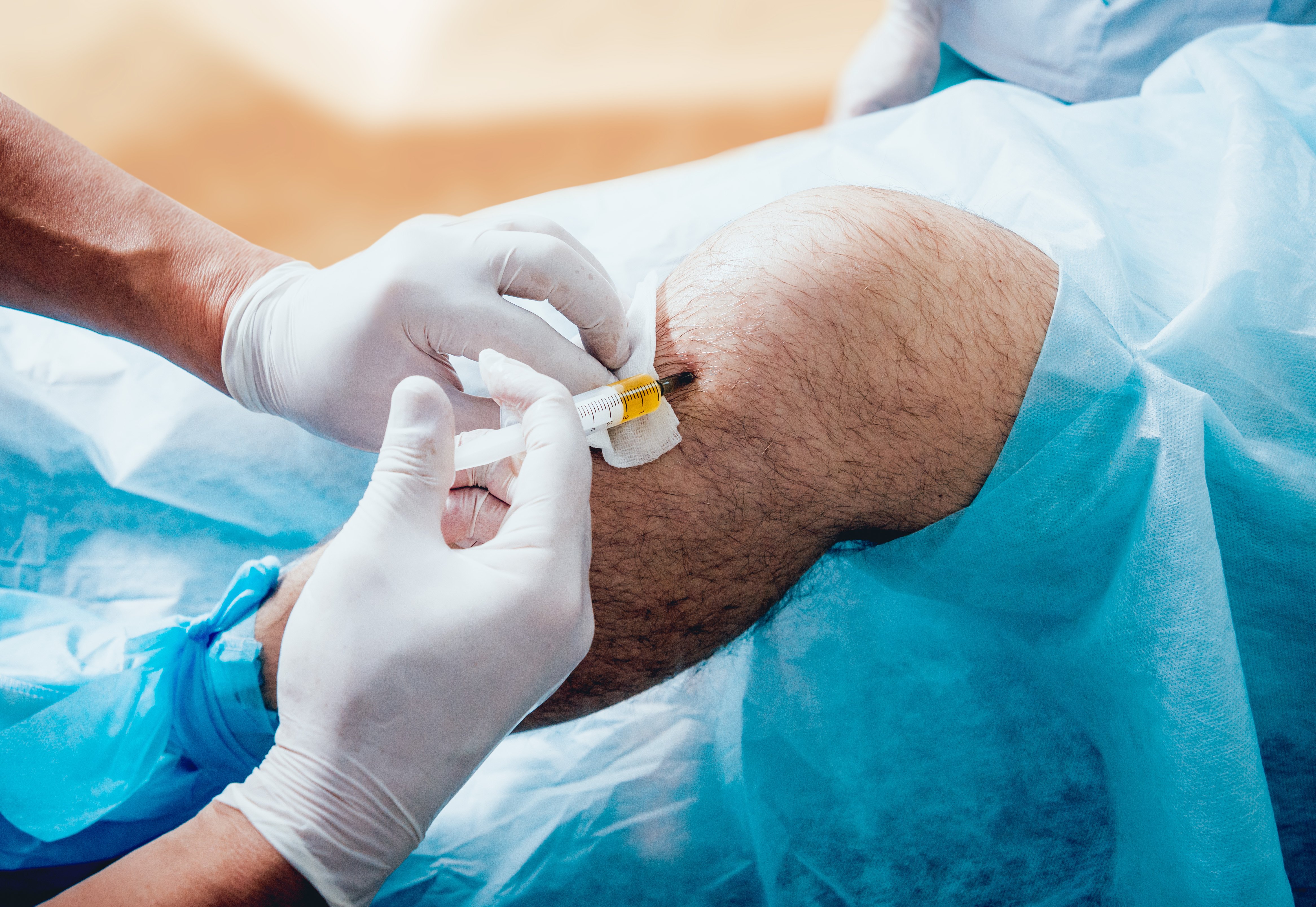
When PRP is injected into an arthritic knee under ultrasound guidance, the growth factors are delivered directly to the area of joint damage. The biological response takes time. Most patients do not notice significant improvement in the first two to four weeks. The effect builds as the tissue responds to the repair signals over the following months.
This timing difference is the source of most of the confusion in how these treatments are compared.
What the Head-to-Head Research Shows
Multiple randomized controlled trials have now compared intra-articular PRP to corticosteroid injections for knee osteoarthritis. The pattern across studies is consistent enough to draw meaningful conclusions.
A 2020 single-center prospective randomized controlled trial with a one-year follow-up, published in the Journal of Orthopaedic Surgery and Research (Elksniņš-Finogejevs et al., DOI: 10.1186/s13018-020-01753-z), compared PRP to corticosteroid injections in patients with moderate knee OA. Multiple trials in this body of research show PRP and corticosteroids producing broadly comparable results in the earliest weeks, with no dramatic early separation between groups.
Where the two treatments diverge is at six and twelve months. At those time points, PRP consistently outperforms corticosteroids on validated outcome measures including WOMAC scores (which assess pain, stiffness, and physical function) and VAS pain scores. The cortisone group, in many trials, returns to near-baseline symptoms well before the twelve-month mark. The PRP group maintains improvement.
A 2025 systematic review of 60 years of literature comparing the two treatments, published in The Knee (Boffa et al., PMID: 40280053), reinforced this finding: PRP showed comparable short-term results to corticosteroids, but delivered better results at mid- and long-term follow-up, with a higher overall safety and efficacy profile in comparative analyses.
The Cleveland Clinic, reviewing the comparative literature, has reached a similar conclusion: results from comparative studies tend to favor PRP injections over other injection therapies, including steroids and hyaluronic acid, for managing knee osteoarthritis.
This does not mean cortisone has no role. It means the choice between the two depends heavily on the clinical goal and the patient’s timeline.
The Timeline Difference: When Each Treatment Makes Sense
Cortisone is the right tool when the priority is fast, meaningful short-term relief. A patient who cannot sleep due to acute knee swelling, or who has an important event coming up in three weeks and needs functional relief now, has a legitimate reason to consider a cortisone injection. For acute inflammatory flares, cortisone does what it is designed to do.
The problem arises when a short-term tool is used repeatedly as a long-term strategy. Each cortisone injection provides less relief than the one before it. A landmark two-year randomized clinical trial published in JAMA (McAlindon et al., 2017, PMID: 28510679) found that intra-articular triamcinolone resulted in significantly greater cartilage volume loss than saline injections, with no corresponding improvement in pain. Repeated corticosteroid use is associated with the very structural deterioration that causes knee OA to worsen.
PRP is the better tool when the goal is sustained improvement and slowing disease progression. The onset is slower, but the effect is more durable and, critically, PRP does not carry the cartilage risk that repeated cortisone use does. For a patient with mild to moderate knee OA who wants to stay active and delay or avoid surgery, PRP addresses that goal in a way that cortisone cannot.
At ROSM, we do not categorically dismiss cortisone. For the right indication at the right moment, it is an appropriate intervention. What we object to is the pattern of quarterly cortisone injections in a knee that is slowly deteriorating, with no plan for what comes next. That is a pattern that ends in surgery, and it ends there faster than it needed to.
The Cartilage Question: Why the Long Game Matters
Knee osteoarthritis is a structural problem. The cartilage that cushions the joint is degrading. What a patient feels as pain, stiffness, and swelling is the downstream effect of that structural change. Any treatment that addresses the pain without addressing the cartilage is buying time, not solving the problem.
Cortisone buys time. That can be appropriate. But the JAMA data showing greater cartilage loss in patients who received repeated cortisone versus saline injections has changed how many regenerative medicine physicians approach the cortisone-first protocol. If the treatment that is supposed to help you function is also accelerating the structural damage that will eventually require surgery, that trade-off deserves explicit discussion.
PRP does not regenerate cartilage that has already been lost. No injection does that. What PRP can do is support the joint environment in a way that may slow the progression of further cartilage degradation, reduce inflammatory load, and improve the biological conditions within the joint. For a knee that still has meaningful cartilage remaining, that distinction is clinically significant.
Who Is a Good Candidate for PRP vs. Cortisone?
The two treatments are not mutually exclusive, but the decision tree for which to use first depends on several factors.
PRP tends to produce the best results in patients with mild to moderate knee osteoarthritis (Kellgren-Lawrence grade 1 to 3), active patients who want to preserve function long-term, patients who have had cortisone injections that are providing diminishing returns, patients who want to avoid surgery and need a durable non-surgical option, and patients with chronic knee pain that has persisted for more than three to four months without adequate response to physical therapy alone.
Cortisone may be the more appropriate immediate choice in patients in an acute inflammatory flare who need fast relief to participate in rehabilitation, patients who have a specific short-term need (a trip, an event, a work requirement) within the next few weeks, and as a bridging treatment while PRP response builds.
Some patients receive cortisone first, then transition to PRP once the acute phase has resolved. This is a legitimate sequencing strategy that ROSM physicians discuss on a case-by-case basis, though most ROSM physicians prefer to wait at least six weeks after a cortisone injection before administering PRP.
The determining factor in all of these decisions is a clear diagnostic picture of the knee. ROSM uses same-visit musculoskeletal ultrasound to assess the joint directly: cartilage status, effusion, synovial thickening, and any associated soft tissue pathology. Treatment recommendations follow from what the imaging shows, not from a generic protocol.
Frequently Asked Questions
Q: Is PRP better than cortisone for knee arthritis?
A: In head-to-head clinical trials, PRP consistently outperforms cortisone at six and twelve months on validated pain and function measures. Cortisone tends to provide faster short-term relief. For patients who want durable improvement and who are not in an acute flare, PRP is the better long-term choice based on current evidence.
Q: How long does PRP last compared to a cortisone shot?
A: Cortisone typically provides meaningful relief for six to twelve weeks, with diminishing returns after repeated injections. PRP benefits tend to build over six to twelve weeks and are typically maintained for twelve months or longer in clinical trials. Some patients with mild to moderate knee OA maintain benefit for eighteen to twenty-four months after one or two PRP injections.
Q: Can I get PRP if I have already had cortisone injections?
A: Yes. Prior cortisone injections do not disqualify you from PRP. However, most ROSM physicians prefer to wait at least six weeks after a cortisone injection before administering PRP, as the cortisone’s anti-inflammatory effect can potentially interfere with the growth factor response that makes PRP effective.
Q: Does PRP hurt more than a cortisone injection?
A: Both involve an injection into the knee joint. PRP injections are sometimes described as slightly more uncomfortable than cortisone, partly because the PRP concentrate is slightly more viscous. Both are performed under ultrasound guidance at ROSM, which allows precise needle placement and typically minimizes discomfort. Most patients tolerate both procedures well.
Q: Will my insurance cover PRP for knee OA?
A: Standard insurance does not cover PRP for knee osteoarthritis. Cortisone injections are typically covered. We discuss all costs transparently at your first visit, and HSA and FSA funds can generally be used for PRP. See our full PRP cost and recovery guide for details.
Conclusion
The PRP versus cortisone comparison for knee osteoarthritis is not a competition where one treatment is always right. It is a question of mechanism, timing, and goals. Cortisone is effective for fast, short-term relief. PRP is more effective for sustained improvement and does not carry the cartilage risk that repeated cortisone use does.
For patients with knee osteoarthritis who are managing a chronic problem rather than an acute flare, the clinical evidence increasingly supports PRP as the more appropriate primary intervention. The data is not perfect, and the right answer still depends on the individual joint, the imaging findings, and the patient’s goals and timeline.
If you have knee OA and want to understand which approach is right for your specific situation, a diagnostic evaluation at ROSM is the starting point. We use same-visit ultrasound imaging to assess the joint and give you a clear picture before recommending anything.